

Do you need butyl sealant tape for a manhole, septic tank, box culvert, or concrete pipe? Press-Seal offers three styles of butyl sealant tape to fulfill a wide range of your project requirements!
What Is the Difference Between Press-Seal Butyl Sealant Tapes?
While sealant tapes themselves don’t really vary in function across the market (their adhesive properties consistently do just that: adhere things together), the materials that make them up do.
Utilized across the waterworks industry in water containment systems for stormwater, wastewater, and more, all Press-Seal sealant tapes (EZ-Wraps) comprise high-strength butyl for waterproofing primed concrete surfaces and concrete structure joints, such as manholes. The main difference between our three main tapes, however, lies in their backings: one is rubber, while the other two employ plastic. Different projects call for different compounds, so we decided to excel in as many ways as you need.
Rubber-Backed Butyl Sealant Tapes
Butyl sealant featuring rubber backing is often the preferred choice among sealant tapes because of its UV resistance and ability to withstand tougher conditions, such as extreme heat or cold.
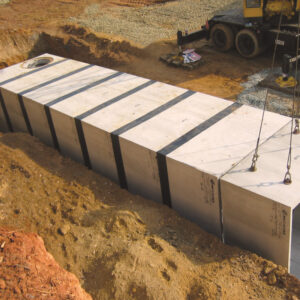
Press-Seal EPDM EZ-Wrap butyl sealant tape on a box culvert.
Our EPDM (ethylene propylene diene monomer) EZ-Wrap is very much considered a high-quality tool in these instances. Have several joints of the same size that need sealed? Contractors love our EZ-Wrap Paks! Press-Seal knows it’s never convenient to cut pieces of butyl tape in the field, so we developed packs of 6-inch-wide (152.4 mm), precut, HDPE EZ-Wrap in 48-, 60-, and 72-inch (1.22 m, 1.52 m, and 1.83 m) lengths. And we never skimp on quantity or quality—we also include the proper amount of canned spray adhesive based on the manhole size.
Plastic-Backed Butyl Sealant Tapes
Plastic-backed butyl sealant tape is utilized in situations where UV resistance is not a top concern, so products with plastic backing should not be stored in climates that may cause the material to crack or break.
Our cost-effective HDPE (high-density polyethylene) and polyolefin EZ-Wraps perform at the highest levels. Both tapes are capable of adhering to concrete, steel, and even glass and come available in 6-, 9-, and 12-inch-wide (152.4 mm, 228.6 mm, and 304.8 mm) options in either 50- or 100-foot (15.24 m or 30.48 m) lengths.
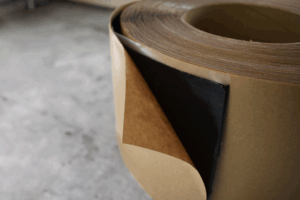
Press-Seal HDPE EZ-Wrap butyl sealant tape.
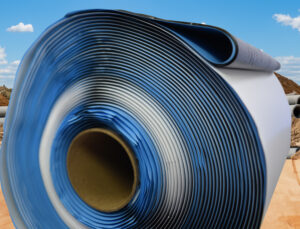
Press-Seal polyolefin EZ-Wrap butyl sealant tape.
How to Install Butyl Sealant Tape to a Concrete Surface
While the design of some butyl tapes, including our offerings mentioned above, support adhesion to glass or metal, Press-Seal butyl sealant tape is best suited for concrete pipes and structures, such as manholes.
No matter how well a structure or pipe is built, small imperfections may exist that can lower the sealing capabilities of the tape. To counteract these potential weaknesses, Press-Seal offers spray adhesive and primer for added sealing capability.
With this in mind, each of our butyl sealant tapes installs the same “EZ” way:
- Stir the primer thoroughly and apply it in a thin layer around the joint at least two inches (50.8 mm) wider than the width of the EZ-Wrap. (If you are using spray adhesive, use a web-pattern motion to prime the surface.)
- Allow the solvents to dispense properly. Wait 10 to 30 minutes (depending on the temperature) to ensure a clean, smooth surface for installation. Never apply EZ-Wrap to wet primer. (If you are using spray adhesive, wait one to three minutes to allow for proper dispensation.)
- Cut the EZ-Wrap to the desired length before applying it to the joint.
- Center the wrap and firmly press during application so both sides of the joint are equally covered. Remove the release paper as the wrap is installed.
- To complete the seal, overlap each end of the EZ-Wrap six to nine inches (152.4 mm to 228.6 mm), but apply primer (or spray adhesive) to the overlapped section of EZ-Wrap before pressing down.
- Allow the solvent (or spray adhesive) to dispense properly before adhering the excess EZ-Wrap portion against the other end, which should already be installed against the concrete surface.
Use EZ-Wrap for Manholes
Use EZ-Wrap on a variety of concrete pipes and structures, including manholes! Not sure which backing to choose? Reach out to us toll free at (800) 348-7325 or locally at (260) 436-0521.