

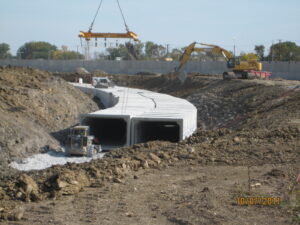
Box culvert. Image provided by O’Hare Pictures.
It’s the building block of underground infrastructure and the alternative to precast concrete pipe. It’s essentially the Lego of modern precast structures that simply snaps together for easy installation.
This is the box culvert, and as with any product that utilizes a joint that could potentially move, an inherent risk of infiltration or exfiltration emerges. Sealing mitigates that risk, but how do you accomplish this? Luckily for you, Press-Seal recommends four distinct ways to accomplish such a project.
But first, let’s dig into the design and intended uses behind the precast box culvert.
Precast Box Culvert Design
As its name suggests, precast box culverts are square or rectangular hollow concrete structures meant to convey water and come in several sizes ranging anywhere from three feet (0.91 m) wide and two feet (0.61 m) tall to 12 feet (3.66 m) by 12 feet. A typical size for a box culvert is six feet (1.83 m) by eight feet (2.44 m).
City or municipality codes will inherently affect the design of a box culvert, especially when nonstandard sizing is required. This is permissible and must be designed per project design specification.
What Are Box Culverts Used For?
Because of their design and scale, precast box culverts can be used for a variety of applications other than just conveying water. Some of these include:
- Pedestrian tunnels. Box culverts are placed under roads or bridges to allow for safe passage of pedestrians or bicyclists.
- Stormwater conveyance. Box culverts allow natural waterways to move under roads and bridges.
- Utility systems. Box culverts are useful as ducts for systems powered by electricity, cable, water, oil, or even steam.
What Do You Use to Seal the Joint on a Box Culvert?
And now we come to our main question: How do you seal a box culvert?
Precast box culverts provide exceptional strength, but no design is perfect—especially when considering how differential settlement can cause fluctuations in the connection. To prevent potential gaps from forming and leaking water in or out at the joint, consider the following sealing applications:
- Exterior joint wrap
- Profile rubber gaskets
- Butyl sealant
- Cellular joint filler
1. Exterior Joint Wrap
Exterior joint wrap is essentially a big piece of tape used as a secondary seal on box culverts, manholes, and even concrete pipe. Press-Seal offers joint wrap in a variety of backing types to suit your project. Choose from our waterproof EPDM-backed EZ-Wrap, our high-strength adhesion HDPE-backed EZ-Wrap, and our all-weather polyolefin-backed EZ-Wrap for any of your box culvert needs. This additional sealing security provides peace of mind knowing that you’ve sealed the structure both inside and out to prevent leaks. For added security, check out our precut EZ-Wrap Pak for manholes—it’s as easy as unpackage, apply, done!
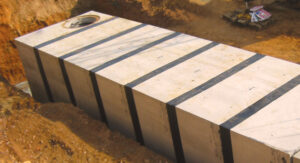
Press-Seal EZ-Wrap applied to a box culvert.
2. Profile Rubber Gaskets
With different joint designs, you’ll need to determine proper gasket type and application, if that is what your project calls for.
Take our 4G wedge profile gasket and RFS (Reduced Friction Seal) pre-lubricated gasket, for example. Both are available for watertight applications meeting ASTM C1677 (Standard Specification for Joints for Concrete Box, Using Rubber Gaskets) and a slew of other specifications, including:
- ASTM C443 (Standard Specification for Joints for Concrete Pipe and Manholes, Using Rubber Gaskets)
- ASTM C1619 (Standard Specification for Elastomeric Seals for Joining Concrete Structures)
- CSA A257.3 (Standards for Concrete Pipe and Manhole Sections)
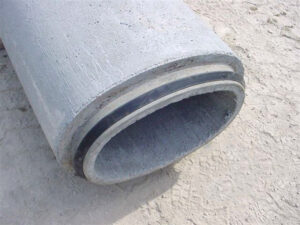
Press-Seal 4G profile gasket applied to concrete pipe.
But rubber gaskets are much more applicable to single-offset joints than, say, tongue-and-groove joints, which would benefit more from butyl sealant. The homing force between a joint and gasket provides greater sealing forces, so you must take into consideration the degree to which your joint is watertight and whether the resiliency of a sealant is as high or necessary as a gasket and vice versa.
3. Butyl Sealant
Speaking of butyl sealant, a tongue-and-groove joint in a box culvert would most likely benefit from our Pro-Stik or our rope-form EZ-Stik. Both meet ASTM C990 (Standard Specification for Joints for Concrete Pipe, Manholes, and Precast Box Sections Using Preformed Flexible Joint Sealants), Section 6.2, and contain neither bitumen nor asphalt materials. As all-weather sealants, they reassure box culvert manufacturers and contractors/installers of maximum performance in both cold- and hot-weather climates.
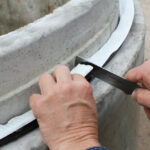
Press-Seal Pro-Stik installation on a concrete pipe.
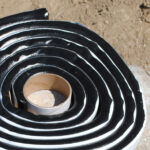
Genius rope form factor of Press-Seal EZ-Stik.
If a cost-effective butyl/bitumen-blend sealant is what you’re after, consider our shrink- and crack-resistant Crete-Stik, which also meets ASTM C990 as it pertains to the compression index per ASTM C972 (Standard Test Method for Compression-Recovery of Tape Sealant).
Press-Seal offers butyl sealant in a wide variety of shapes and sizes to fit some of the most unique box culvert joints on the market today. Check out our trowelable EZ-Stik suitable for pumping or dispensing trowel onto concrete structures!
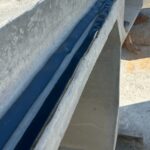
Press-Seal Crete-Stik applied to box culvert.
4. Cellular Joint Filler
For a quick and easy solution for sealing box culvert joints, look to our cellular joint filler to get the job done even faster. Varying sizes and shapes for soil- and silt-tight applications meeting ASTM D1056 (Standard Specification for Flexible Cellular Materials—Sponge or Expanded Rubber) allow you to get the job done right.
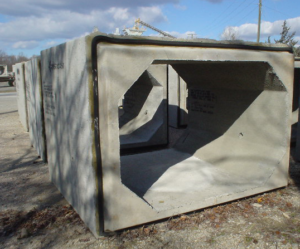
Press-Seal cellular joint filler installed on a closed-cell box culvert.
Your Box Culvert Sealing Solution Is Minutes Away
From exterior joint wrap and profile gaskets to butyl sealant and cellular joint filler, Press-Seal has the solution to your sealing needs! Reach out to us toll free at (800) 348-7325 or locally at (260) 436-0521.